
Object Record
Images

Metadata
Title |
Qing (Ch'ing) Dynasty Coin, c. 1736-1911 |
Object Name |
Coin |
Description |
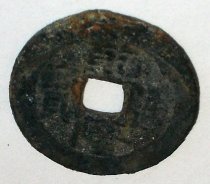
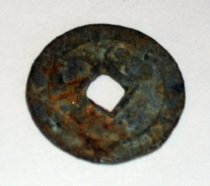
Qing (Ch'ing) Dynasty coin from a former Chinese Village site in Redwood City, c. 1736-1910. Coin was probably left on site between 1870 and 1910. Brass metal coin is round with a square opening in the center. There is an embossed outer rim on outer edge of both sides. Inside on one side are embossed Chinese Characters [see image for characters and translation]. |
Date |
c. 1736-1910 |
Catalog Number |
2015.036.001 |
Dimensions |
H-0.875 W-0.875 inches |
Collection |
3D - Exchange Media |
Inscription Text |
Embossed Chinese characters for "Qian Long Tong Bao"on one side translate to "Qian Long - 'Access to goods'" |
Inscription Language |
Chinese |
Inscription Translation |
"Qianlong Reign" |
Provenance |
Qing (Ch'ing) Dynasty coin recovered by donor in 2010 from Redwood Creek (near a former Chinese Village site) in Redwood City |
Notes |
While this coin had no monetary value with whites, Chinese did use them for trade among themselves in their China Camps. "...Thousands of Chinese helped the Central Pacific Company build the rails from west to east. When the job was done, they were released to find employment in other places. Many wished to engage in occupations they knew best back in China-and many had been skillful fishermen. Unfortunately, discriminatory laws kept the Chinese from being able to fish for most catches. Because there was limited white competition with it, many turned to shrimp fishing, with which they had considerable experience back home. "Along the bayline off Marin, San Francisco and San Mateo counties, 'China Camps' materialized as bases of operation for the shrimp fishermen. The first formed in San Mateo County was at Redwood City in 1869. By 1880, the most important camp existed at San Bruno Point. Here, dozens of men sailed 12 junks and snagged hundreds of tons of shrimp with 100 nets. The Chines established other significant camps at Burlingame and San Mateo. The census of 1880 tells us that 177 Chinese shrimp fishermen were in the county. However, the tally was taken in the off-season, when fewer were present." [Postel, Mitchell P. "San Mateo County: A Sesquicentennial History." Belmont: Star Publishing Company, Inc., 2007.] "The Qing ( meaning 'pure ' ) Dynasty ( 1644 - 1912 ), also known as Ch'ing or Manchu, was the last of the Chinese dynasties. During the Qing period, imperial China reached its zenith of power and influence with a population growth from 150,000,000 to 450,000,000. The Qing extended China's borders farther than they had ever been before, and perfected the imperial system. There were 12 rulers of Qing Dynasty. From the Emperor Nurhachi built the Manchu state (which located at North East of China) titled as"Tian Ming"outside the Shanhaiguan Pass in Year 1616 to the last Emperor Xuan Tong abdicated in Year 1911. The Qing Dynasty issued coins all long in every reign with varied coinages. Qian Long Emperor (the sixth ruler of Qing Dynasty) issued a huge amount of coins during his reign as long as sixty years with a standard style that there are Manchu characters only on the reverse of a coin indicating the name of its mint. This period Qian Long achieving greatest prosperity of Qing Dynasty, there were 24 mints had issued coins but the quality was gradually reduced in the latter stage. " [http://www.goodorient.com/Chinese_Qing_Dynasty_Coin_Series---Qianlong_P27334 12/31/2015] |
Search Terms |
Chinese Chinese - Fishing Camp Chinese - Shrimp Industry Chinese camp Coins Money |
Subjects |
Money Coins |
People |
Lung, Emperor Ch'ien |
Credit line |
Courtesy of John Shroyer |