
Object Record
Images
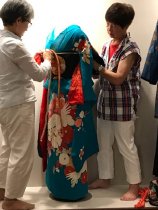
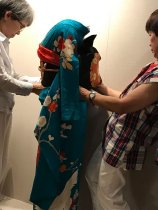
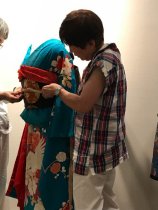
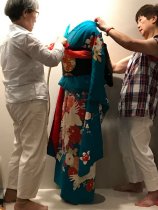
Additional Images [11]
Metadata
Title |
Kimono, Obi and undergarments, c. 1950-1960s. |
Object Name |
Kimono |
Description |
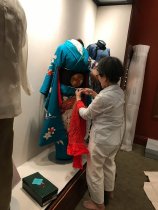
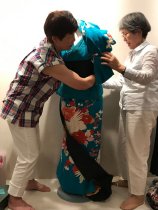
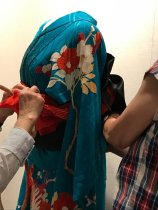
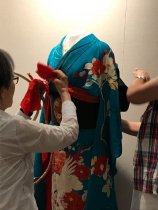
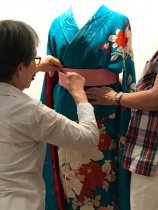
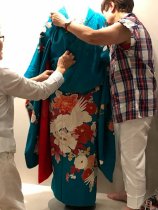
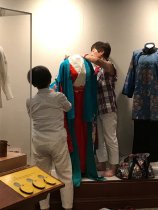
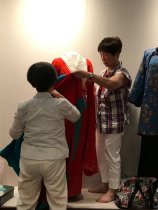
Kimono, Obi and undergarments, c. 1950-1960s. The Japanese kimono is primarily turquoise in color with red, pink, yellow, and gold floral designs on the front, back, and sleeves. Throughout the turquoise color is floral pattern. On the front is a large, white bird with a gold and red eye. There are three layers visible. The two visible under garments are an off-white color, with one having a floral pattern. The underside of the sleeves are red with a floral pattern as well. The obi is primarily black with a green, white, gold, and red circular, floral pattern in the front (as displayed). Above the obi is a red and white twisted scarf? twisted and tied around the breast plate. Across the middle of the obi are two twisted cords. One is off-white and gold and the other is red and gold. It appears that this kimono has multiple layers. The split toe socks are white can be fastened by attaching five silver, half-oval pieces to pieces of string. |
Date |
c. 1950-1960s |
Creator |
Unknown |
Role |
Manufacturer |
Catalog Number |
2019.032.001 |
Dimensions |
H-50 W-24 inches |
Dimension Details |
As displayed. |
Collection |
3D - Clothing |
Inscription Text |
None. |
Provenance |
Purchased at Takashimaya Department Store in Toykio, Japan. Used by Laura Watanuki. |
Notes |
"In Japanese culture, the kimono is worn in a formal or celebratory ceremony. In the case of tea ceremony, usually a plain or undecorated kimono is worn. Patterns are acceptable as long as the kimono is not flashy. For men, hakama are worn. White split-toe socks are worn by both men and women, and are taken off and changed out before heading into the tea ceremony room. If you do not own a kimono, western clothing is also acceptable in most situations. For the most part, you can use common sense when choosing clothing. Don’t wear anything that is too flashy or too casual. Women should not wear revealing clothing or skirts shorter than knee-length (which can also be problematic when sitting for long periods of time). Men are expected to show up in a suit and necktie." [https://www.toki.tokyo/blogt/2017/2/6/participating-in-tea-ceremony] |
Search Terms |
Costume and Fashion Costumes Dress Japan Japanese Watanuki, Laura |
Subjects |
Clothing & dress Japan Japanese clothing Japanese tea ceremony Kimonos |
People |
Watanuki, Laura |
Credit line |
Courtesy of Laura Watanuki |