
Object Record
Images
Additional Images [1]
Metadata
Title |
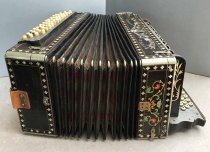
Accordion c. 1930-1950s |
Object Name |
Accordion |
Description |
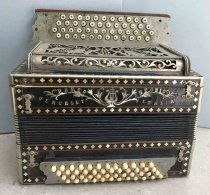
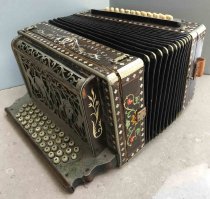
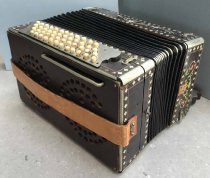
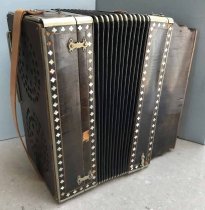
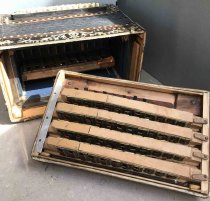
Accordion c. 1930-1950s. Wooden accordion is in three parts held together swinging metal hook clasps. Center piece has expandable pleated section covered with fabric, blue on the interior and red and white on the outside. Piece to one side is topped with ivory keys. It's side is solid wood with two large circles of perforated circular openings. Across the openings is a 1.625" wide brown leather strap affixed to the ends via a metal plate and two screws on each side. Opposite side is metal with a cut-out motif of flur de lis, mandolins, trumpets and monkeys. Below this is a horizontal metal covered piece with mother-of-pearl keys. Exterior has a brown lacquer laminate inlaid with floral motifs and mother of pearl in floral, clover and harp motifs. "RANCO ANTONIO / VERCELDI ITALIA" is inlaid in mother-of-pearl on top of center piece surrounding an inlaid harp with vines and flowers coming out from it. All exterior corners are rounded silver colored metal. Interior has brass metal pads mounted on top of light yellow leather with red leather strips on top. |
Date |
c. 1930-1950s |
Creator |
Unknown |
Role |
Manufacturer |
Catalog Number |
2020.027.002 |
Dimensions |
H-8 W-13 D-13.5 inches |
Collection |
3D - Musical Tools & Equipment |
Inscription Text |
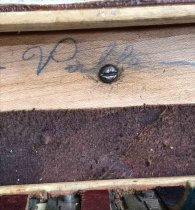
"RANCO ANTONIO / VERCELDI ITALIA" (mother-of-pearl inlay on top of center section); "Porlle" ([sp.] signature in pencil on interior of piece with metal side); "1 / 2 / 3. / 4." (handwritten in pencil on horizontal wooden strips on interior of piece with metal cut-out. |
Provenance |
Belonged to Italian Immigrant Sagredo Rodolari who owned Rodolari Market in San Mateo from c. 1930-1950s. Rodolari would play this accordion at weddings, parties and social club functions. |
Notes |
"By John Crawford (Freuchie) "Antonio, Fratello and Guiseppe Ranco began building accordions in Vercelli, northern Italy in 1890. They were the first to manufacture accordions in that area. All three were, I think, brothers. They opened a factory in 1912. They were pioneers in the art of accordion construction. They made many different models, including ‘specials’ for stage stars of the day and top accordionists from all over the world. "Ranco manufactured piano and button instruments, two and three row diatonics and three, four, five and six row Continentals with B or C systems. They also experimented with variations such as a right hand with piano keys plus two or three rows of buttons on the outside of the keyboard. "Some of the innovative features on Ranco accordions were as follows – the treble and bass pallets were floating, so that they could lie at an angle and ensure perfect bedding with no loss of air. Some of the ‘specials’ had leather on the sound board which helped to seal and quieten the pallet noise. "The reed plate were made from Duralium, not aluminium. This metal gives a far better tone to the instrument than any other metal. The reed tongues are Swiss cobalt steel. The reed plates are fitted on the bridges to the bare wood and are pinned and glued – no wax was used. A thin acoustic membrane placed on the solid wood of the casework increases the tonal strength of the instrument to a considerable extent. This amplification system could penetrate to the farthest corners of the largest auditorium which was a necessity in the days before electric amplification. "All Ranco accordions were guaranteed for five years for defects and workmanship." Antonio Ranco had three sons, Antonio Jnr, Luigi and Guglielmo. Luigi went on his own and built accordions to order. He built a three row, three voice, 72 bass, diatonic for Emile Vacher which he used for his first 78s. Guglielmo also went on his own and made good instruments. Antonio Jnr had a son Guiseppe, who is today building Ranco accordions. Antonio Jnr himself died in 1966. "In 1926 the Ranco brothers employed over sixty workers. It was a sad day when the Ranco factory closed down in the 1960s but it was a boost for Hohner and others and in particular for the Morino and Atlantic models at that time. Antonio Snr did not allow his sons to use the Ranco name on the reeds – only Antonio Jnr was permitted to do so. In 1935 you could buy a 4 voice Ranco for £57. The Supervox was, and still is, the best Ranco ever built. They were available in four and five voices." [https://boxandfiddlearchive.weebly.com/history-of-ranco-accordions.html 02/11/2021] |
Search Terms |
Rodolari, Sagredo Music Musical Instruments |
Subjects |
Accordions Music |
People |
Rodolari, Sagredo |
Credit line |
Courtesy of Noelle Rodolari |