
Object Record
Images
Metadata
Title |
Poly-X Commemorative Plaque with Roller Dies, April 22, 1977 |
Object Name |
Plaque |
Description |
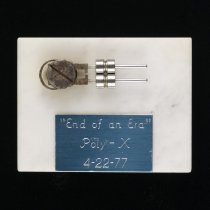
Poly-X Commemorative Plaque with Roller Dies, April 22, 1977. Produced in the 1970s, Poly-X (Polyimidal) was a mixed aromatic polyimide or "alkane-imide" insulated wire preferred for commercial and military aircraft construction because it weighed substantially less than other available products. In-line roller dies, such as the pair mounted on the plaque, were used to perform a 100% QC (Quality Control) check on the wire. The rectangular plaque is made with light gray stone and shows a pair of roller dies and hardware with a blue inscription plate underneath. The rollers and hardware are aligned at top left on the stone and measure 0.75" height x 2.75" wide x .05" deep. Each 0.5" diameter cylindrical die is threaded on a metal rod of a split pin-like piece of hardware. A screw with a flat head extends through a 0.5" hole in the stone at the top left corner and is held in place with a recessed bolt. The split pin is attached around the screw and can be rotated 360 degrees or removed if the metal rods are pulled apart. The 0.5" x 2.5" blue metal inscription plate adhered at bottom center reads, " 'End of an Era' / Poly-X / 4-22-77." Four 0.5" green felt circles are adhered to the stone's bottom corners. Doctor Leon Glover, a former Raychem employee and Tyco Electronics Technical Fellow, notes that the manufacturing process for Poly-X began with thermoplastic polymer pellets made at Menlo Park that were shipped to Redwood City and extruded over tin-plated copper wire. That composite would be coated in nine very thin imide layers in a magnet wire tower that was heated, evaporating out the solvent. For quality control, intermediate Poly-X wire from the tower would undergo an annealing process where it was heated at a constant temperature and run back and forth over and under roller dies at high speed. This was an extra step particular to the tin-plated copper wire, which required very precise manufacturing conditions. If under cured, the wire would crack as it ran through the roller dies and if over cured, the copper and tin would form an alloy. Poly-X wire was checked by hand after the annealing process, and if cracks were found that batch of wire would be thrown out. The tin-plated copper conductor was requested by Boeing, one of Raychem's main aircraft clients. |
Date |
April 22, 1977 |
Creator |
Unknown |
Role |
Artist |
Catalog Number |
2016.015.002.30 |
Dimensions |
H-3.5 W-4.5 D-0.75 inches |
Dimension Details |
3.5" x 4.5" x 0.750 |
Collection |
3D - Ceremonial Objects |
Inscription Text |
"`End of an Era' / Poly - X / 4-22-77" (inscribed in metal plate at bottom center); "106" (inscribed on screw head); "A" (inscribed on lower roller die, right side); "78" (inscribed on upper roller die, right side) |
Search Terms |
Business and Industry Commemorative Manufacturing Raychem Corporation Raychem Corporation Memorabilia Raychem Culture |
Subjects |
Commemoration Industry Products Radiation chemistry Wire |
People |
Clifford, Thomas |
Credit line |
Courtesy of the Raychemers |