
Object Record
Images
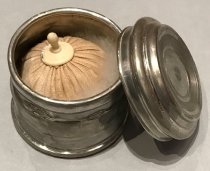
Metadata
Title |
Tin with Lid |
Object Name |
Tin |
Description |
Tin with Lid. The lid to the container has circular designs on it; in the middle is a small circle, surrounded by a larger one which is also surrounded by a larger one. This part of the design is raised from the rest of the lid. The lid is narrower at the bottom and would be inserted onto the container. Main container has horizontal ribbing at the top where it meets the lid and again at the base. The base extends out to stabilize the unit, inside at the bottom there are rings expanding out wards from the center. |
Date |
n.d. |
Creator |
Unknown |
Role |
Manufacturer |
Catalog Number |
1963.115.002 |
Dimensions |
H-2 W-2.5 D-2.5 inches |
Collection |
3D - Containers |
Inscription Text |
none |
Notes |
Received January 8, 1963 "(...) compacts were born in the Edwardian era, a time when makeup was still controversial, so powder cases were disguised as a component of more socially acceptable accessories, such as walking sticks, hatpins, or necklaces. Beginning in 1896, according to R. Gerson in Vintage & Vogue Ladies’ Compacts, mesh handbag manufacturer Whiting & Davis Company of Plainville, Massachusetts, created a case-like lid for its bags that featured compartments for powder, rouge, or combs. From its first formal appearance in 1908, until its unceremonious demise in the mid-1950s, the decorative compact was a veritable shape shifter. For the majority of the compact’s run as a "must-have" fashion accessory, metal was used because it was readily available, cheap to produce, and could be brushed, enameled, engraved, and painted. Ettinger notes that sterling silver was extremely popular, as was brass, aluminum, gunmetal, nickel, and gilt." [http://www.americanpopularculture.com/archive/style/compact.htm 05/13/2019] |
Search Terms |
Personal Items |
Credit line |
Courtesy of Mrs. I Perham Story |