
Object Record
Images
Metadata
Title |
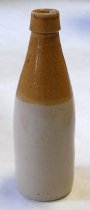
Ceramic Beer Bottle, c. 1880-1899 |
Object Name |
Bottle, Beer |
Description |
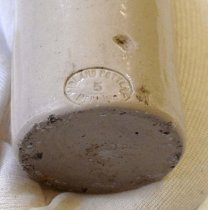
Ceramic Beer Bottle, c. 1880-1889. Two-toned cylindrical beer bottle with round base. The top portion is a light brown color while the bottom portion is a white/cream color. The cylindrical shape of the bottle tapers off towards the neck. The lip extends out and is wider than the neck. There is a semi sharp transition between the neck and the lip on the bottle. Just barely above the edge of the base there is an engraved stamp in small and bold lettering that says "MIDLAND POTTERY / 5 / MELLING". |
Date |
c. 1880-1899 |
Creator |
Midland Pottery, Melling, England |
Role |
Ceramicist |
Catalog Number |
2017.012.043 |
Dimensions |
H-8.5 W-2.5 D-0.125 inches |
Collection |
3D - Food Service Tools & Equipment |
Inscription Text |
"MIDLAND POTTERY / 5 / MELLING" (engraved in small and bold lettering on a stamp on the bottom portion of the bottle) |
Provenance |
Part of donation that included 6 cases of beer and whiskey bottles dating from 1850 through the 1890s. These are the type of bottles that would have been present in San Mateo County during that time period. |
Notes |
"Throughout the 18th, 19th, and early 20th centuries beer, as well as many non-alcoholic beverages, was commonly bottled in stoneware bottles like those shown to the left. Stoneware bottles did provide the ultimate in protection from the detrimental effects of light though had other problems that eventually lessened their popularity, e.g., weight (heavy) and closure limitations. The two-tone stoneware bottle pictured to the far left [picture shown was of a champagne shaped bottle with a medium brown colored top and a cream colored bottom] was made in Great Britain during the 1870s or 1880s. Many stoneware bottles found in the U.S. were imported from Great Britain and are a very common item on 19th century historic sites (Switzer 1974; Wilson 1981). This bottle also had a fragmental label noting that it contained either ale or stout (i.e., "Ale/Stout"). The medium brown stoneware bottle to the immediate left is almost certainly American made (incised with J. L. SCHRIBER on the shoulder) and is fairly typical of a U. S. made item from the 1850 to 1890 era (Peters 1996). (Photo from eBay®.) Stoneware or ceramic bottles for beer were generally discontinued in the U. S. after about 1895 (Graci 1995). However, the subject of stoneware or ceramic bottles is beyond the scope of this website and the subject is not covered further." [https://sha.org/bottle/beer.htm 09/19/2017] "Ale and Porter were bottled in the United States from at least 1844, usually in cork-stoppered, ceramic bottles. These bottles were generally discontinued after 1895 (Graci 1995:14), but some were still in use as soft drink bottles until at least the mid-1920s (cf. Lockhart 2000). For practical purposes, however, the ceramic containers became a dead end before the turn of the century." [https://sha.org/bottle/pdffiles/ExportBeerBottles_BLockhart.pdf 09/19/2017] "As with beer and ale, different soft drinks and mineral water were bottled in non-glass containers. This included the ale style stoneware bottles... Root beer was commonly dispensed in stoneware bottles during the 19th century, particularly east of the Mississippi... Mineral water was also sold in larger ceramic or pottery jugs... It should also be noted that bottles strongly identified with beer were also used (or re-used) for the bottling of soda and mineral water." [https://sha.org/bottle/soda.htm 09/19/2017] "In 1872 Scottish potters first started to arrive in Melling from Rutherglen near Glasgow in Scotland, with Mr Service [Mr. Edward Service], to set up a new factory under his management... The reason why the stamp ‘Midland Pottery Co.’ was used is unknown, did the migrant Scots think they had reached the Midlands which is renowned for their famous potteries... The only stoneware pottery in the district, the factory consisted of three kilns, warehouses, sheds and six double cottages. Clay from Devonshire was shipped to Stanley Docks in Liverpool where it was put on to a barge to the door of the pottery works. Being close to the canal meant that delivery was quick and cheap. The water from the canal was also used for the manufacturing process. Coal to fire kilns was brought by barge from Wigan." [http://www.mellingparishcouncil.co.uk/index.php/melling-parish-coucil-community/history-of-melling-pottery 09/19/2017] "Glasgow produced a wide range of ceramics for the domestic and export market in the form of containers and tablewares, often catering for the needs of the countries of destination... Glasgow's importance as a major manufacturing center grew during the 19th century with its increase in population and easy access to coal and other raw materials." [https://books.google.com/books?id=TCTnCgAAQBAJ&pg=PA100&lpg=PA100&dq=stoneware+beer+bottles+19th+century+west+coast&source=bl&ots=8k2T-1wSjt&sig=ucEkrDnyBJbKncMIaKZaEVqLmsk&hl=en&sa=X&ved=0ahUKEwiM3tT96bHWAhUKwFQKHQzMDioQ6AEISjAM#v=onepage&q=stoneware%20beer%20bottles%2019th%20century%20west%20coast&f=false 09/19/2017] |
Search Terms |
Alcohol Beer Bottle Collection Bottles Ceramics San Mateo County San Mateo County - History Stoneware |
Subjects |
Alcoholic beverages Beer Bottle industry Bottles Drinking vessels Pottery Pottery industry Stoneware |
Credit line |
Courtesy of John Shroyer |