
Object Record
Images
Metadata
Title |
Victoria, 1903 |
Object Name |
Victoria |
Description |
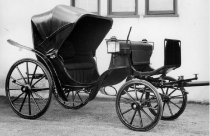
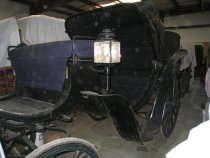
Victoria, 1903. Made by Brewster and Co. Black paint with blue striping. Patent leather fenders; pair of Brewster lanterns. Without doors, lowslung and has a single forward-facing seat. Is driven by a coachman from a high seat and drawn by a single horse or a pair. Soft tufted-calf upholstery. Push hand-brake with steel blocks; child's seat and two foot cushions, apron and seat cover. This specification sheet for this vehicle describes it as a "Standard P.B. [panel boot] Victoria." The drawing for it is #23958. Fabrication started in October 23, 1903 and it was sold July, 1904 to William Bowers Bourn. The body and undercarriage were painted black and the fabric was black wool broadcloth with plain black carpet. It has a child’s jump seat and. The lamps were #4 Square French. It was sold to him second hand for $2,800.00 and shipped August 1904 to San Francisco. The vehicle weighed 1,060 pounds when completed. As with other vehicles made for the Bourn family to use in hilly California, this vehicle has a hand brake that slows momentum while going downhill. Accessories included an apron and seat covers for inclimate weather. As with Mrs. Roth’s other vehicles, this has been painted with black with blue stripes. Typical of Victorias, the body has graceful lines that are complemented by the curved fenders attached to the step. Maker: Brewster & Company, NY. Part of the San Mateo County Historical Association's carriage collection. |
Date |
1903 |
Creator |
Brewster & Company, NY |
Role |
Manufacturer |
Catalog Number |
1973.424 |
Dimensions |
H-84 W-69 D-132 inches |
Collection |
3D - Land Transportation Tools & Equipment |
Provenance |
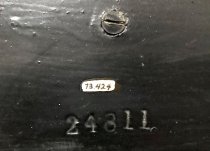
-This specification sheet for this vehicle describes it as a "Standard P.B. [panel boot] Victoria." The drawing for it is #23958. Fabrication started in October 23, 1903 and it was sold July, 1904 to William Bowers Bourn. It was sold to him second hand for $2,800.00 and shipped August 1904 to San Francisco. The vehicle weighed 1,060 pounds when completed. As with other vehicles made for the Bourn family to use in hilly California, this vehicle has a hand brake that slows momentum while going downhill. Accessories included an apron and seat covers for inclimate weather. [Carriage Consultant Merri Ferrell 8/2021] -From the Roth Collection at Filoli. -The Roth Collection is particularly significant as all of the carriages were built by one of the two Brewster firms in New York City, producers of the finest quality vehicles for America's leading families. The National Carriage Association in Staten Island has the original records of the Brewster Company. Since Roth carriages were produced for use in California, they evidence some special changes to adapt them to their owner's way of living. As of June 10, 1973, each carriage was in superb condition, never having been restored. Each carriage bears an individual registration number from the factory. The carriages were built almost entirely of wood, and many coats of paint were applied, each coat rubbed and polished until it was mirror-smooth. As the paint of that era dried slowly, there often was more than a week's wait between the application of coats. |
Notes |
The Victoria was names after Queen Victoria of England. It was a formal vehicle driven by a coachman accompanied by a groom. It had a round body and was usually suspended low to the ground for accessibility. A folding top covered the passengers. Some included a jump seat for children. [Carriage Consultant Merri Ferrell 8/2021] The victoria was an elegant French carriage, possibly based on a phaeton made for George IV. A victoria may be visualised as essentially a phaeton with the addition of a coachman's box-seat. [http://en.wikipedia.org/wiki/Victoria_(carriage)] Currently in storage and not available for viewing. "Brewster & Co. was founded by Henry Brewster, a son of James Brewster, a noted early-19th-century carriage builder at New Haven. Henry Brewster's firm was founded in 1856 and was first known as Brewster of Broome Street, New York, but changed the name to Brewster & Co. when its main office was moved to Broadway and 47th Street in 1874. Under the direction of John W. Britton, one of the partners in the firm, Brewster & Co. became the leading builder of high-class carriages in the U.S., and enjoyed the custom of most of the prominent personalities in New York society and elsewhere." [https://carriageassociationofamerica.com/carriage-tour/stanhope-gig/ 08/02/2018] "These open, four-wheeled vehicles with folding tops were of English origin and were also known as cabriolets. This version was named by the French to honor Queen Victoria of England about 1844. It is characterized by a low-slung body for easy access and graceful lines. It was a preferred vehicle for park driving, since its open body and folding hood afforded a good view of the passengers. Many victorias had a skeleton boot supporting the coachman's seat that could be removed for more formal occasions when the victoria was driven postilion." [Museums at Stony Brook. The Carriage Collection. Stony Brook, New York: The Museums at Stony Brook, 1986. p. 60] |
Search Terms |
Carriage Filoli Roth, William P (Mrs.) Roth, Lurline Matson |
Subjects |
Carriages & coaches Transportation |
People |
Roth, Lurline Matson Roth, William P. Mrs. |
Credit line |
Courtesy of Mrs. William P. Roth |