Object Record
Images
Metadata
Title |
Bay Meadows Money Clip |
Object Name |
Clip, Money |
Description |
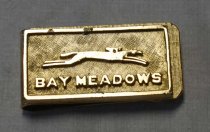
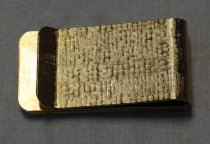
Bay Meadows Money Clip. Small metal, gold colored clip with embossed Bay Meadows logo on front. The logo shows an elongated horse with a jockey riding it; the is presumably racing because all four limbs are extended outwards. Below the image of the horse and rider is embossed "BAY MEADOWS." The logo is housed in a metal, gold rectangle with raised edges, which rests on top of the money clip . The clip has fine etchings all over and add a textured feel. The etching within the rectangle are lines. The clip is curved and almost folded completely over. The end of the piece, on the back flairs outwards so when resting on a flat surface, the clip is laying relatively flat. The back is shorter than the top. |
Creator |
Bay Meadows Race Course, San Mateo |
Role |
Manufacturer |
Catalog Number |
2016.033.005 |
Dimensions |
H-10 W-10 D-1.125 inches |
Collection |
3D - Personal Objects |
Inscription Text |
"BAY MEADOWS" (embossed on front) |
Provenance |
Souvenir money clip from the Bay Meadows Racetrack. |
Notes |
"Bay Meadows Racetrack Of all the Bay Area’s lost tracks, amongst the famous and most mourned is that of Bay Meadows; it is certainly that freshest to memory. Until its closure in 2008, it was not only California’s oldest racecourse in constant operation, but also its most progressive. It introduced the automatic totalisator to the West Coast, pioneered the electric, fully-enclosed starting gate and photo-finish camera, and in 1945, hosted El Lobo, the first horse to travel by air to a race, who, after landing on the airstrip adjacent to the track, went on to triumph in the Burlingame Handicap. Bay Meadows was the brainchild of Bill Kyne, one of the principal champions of the successful campaign to legalise pari-mutuel betting in California in 1933. Less than a year after the passage of the Woolwine-Maloney Bill, Kyne broke ground on the site of the former Curtis-Wright airport. After 209 days of construction, Bay Meadows opened to a crowd of 15,000 on Nov. 4, 1934. The track was fast, a mile-long oval with a half-chute, and was overlooked by a grandstand and clubhouse capable of seating 6,500. The steel and concrete grandstand ran 400 feet in length, with three levels of tiered seating. Its façade was adorned with Art Deco detailing, a feature shared by the timber-framed, stucco-clad clubhouse. This was smaller than the grandstand, at 123 feet in length, and mostly occupied by a single club room. The totalisator was a major attraction at the course; Kyne called it his "mechanical preventative of racetrack chicanery." Under Kyne’s tenure, Bay Meadows enjoyed success after success. It drew celebrities of the equine world such as Seabiscuit, Citation, Determine, John Longden, and Bill Shoemaker, watched by the celebrities of Hollywood including Al Jolson, Mae West, Clark Gable, and Bing Crosby. Thanks to Kyne’s negotiations with the federal government, Bay Meadows remained open throughout World War II, the only major racecourse on the West Coast sanctioned to do so. Certain conditions were imposed upon it, though, not least that 92 percent of profits be donated to the war effort. By 1945, more than $4 million had thereby been raised. Bay Meadows’ 1949 season welcomed a $1.2 million remodelling. With a new clubhouse, private turf club, and grandstand extension, its capacity was doubled to 40,000. Also including a new saddling paddock, fireproof horse barns, and new landscaping, the renovation prompted the Stockton Record to proclaim Bay Meadows "one of the most elaborate racing plants in the world." With racing schedules spread between northern and southern California, Bay Meadows consistently drew high-quality horses and jockeys, and the crowds followed. However, gradually the southern California season grew more profitable and longer in length, and attention shifted away from the Bay Area. By the early 1980s, Bay Meadows was struggling. In 1986, a four-year remodelling project commenced in a bid to rekindle the track’s 1930s glamour. The renovation proved no magic fix – in the face of stockholder infighting, competition for fixtures, and the declining popularity of the sport, the track experienced difficulties throughout the 1990s. Investors vied for control of the land, and by the 2000s rumours circulated about Bay Meadows’ closure. The death knell came with a 2006 mandate from the California Horse Racing Board requiring that major dirt tracks in the state be replaced with synthetic surfaces. Unable to meet the installation costs of up to $10 million, Bay Meadows was scheduled for demolition. On Aug. 17, 2008, 8,000 patrons attended the final day of live racing at the track and bid farewell to California’s oldest continuously-operated racecourse." [https://www.thoroughbredracing.com/articles/looking-back-lost-tracks-san-francisco-bay-area/ 10/19/2017] |
Search Terms |
Bay Meadows Bay Meadows Race Track Horse Racing Horses - Thoroughbred Racing Souvenir |
Subjects |
Horse racing Souvenirs |
Credit line |
Courtesy of the Estate of Paul Gillespie |