
Object Record
Images
Metadata
Title |
Scale Model Ship Lurline, by Charles Parsons |
Object Name |
Model, Instructional |
Description |
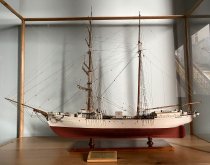
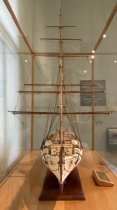
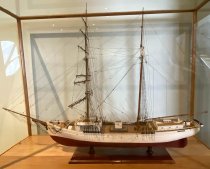
Scale Model Ship Lurline, by Charles Parsons, 1991. This is a 1:64 scale model of an 1887 brigantine, which is a two masted sailing ship, named Lurline, constructed by Charles Parsons. The model sits atop a wooden base. The base has two turned, wooden legs as support, which connect to the flat, rectangular base. The hull of the ship model is painted red and the top of the model's hull is painted white. There is a deckhouse and a cockpit on the deck of the ship which are also painted white, with blue trim. There are two dinghies on the deck, both painted white with blue trim, and one dinghy hanging off the back of the stern, which is painted white with blue trim along the top. Near the stern, on the side of the ship, the stern board reads, "LURLINE" on a slate gray background in silver text. |
Date |
1991 |
Creator |
Parsons, Charles |
Role |
Artist |
Catalog Number |
2022.018.001 |
Dimensions |
H-32 W-44 D-20 inches |
Dimension Details |
32 x 44 x 20 |
Collection |
3D - Documentary Objects |
Provenance |
Model constructed by Charles Parsons at his home in San Carlos. According to the plaque the ship was built in 1991. |
Notes |
"This brigantine was a pioneer ship of the Matson Navigation Company. Built in Benicia, California, the 47-ton yacht was originally owned by sugar magnate Clause Spreckels. He sold the ship to William Matson in 1887. It was the first of six Matson-owned vessels named Lurline. The businessman also named his daughter, Lurline Matson Roth, after this ship. Matson used the Lurline to carry plantation supplies and merchandise to Hawaii." -SMCHA Exhibit Label "William Matson had first come to appreciate the name in the 1870s while serving as skipper aboard the Claus Spreckels family yacht Lurline (a poetic variation of Lorelei, the Rhine River siren) out of San Francisco Bay. Matson met his future wife, Lillie Low, on a yacht voyage he captained to Hawaii; the couple named their daughter Lurline Berenice Matson. Spreckels sold a 150-foot brigantine named Lurline to Matson so Matson could replace his smaller schooner Emma Claudina and double the shipping operation, which involved hauling supplies and a few passengers to Hawaii and returning with cargos of Spreckels sugar. Matson added other vessels to his nascent fleet and the brigantine was sold to another company in 1896." Wikipedia [https://en.wikipedia.org/wiki/SS_Lurline_(1932)] (Footnote references: Krantz, Lynn Blocker; Nick Krantz; Mary Thiele Fobian (2001). To Honolulu in Five Days: Cruising Aboard Matson's S.S. Lurline. Ten Speed Press. ISBN 1580082327.) "A brigantine is a two-masted sailing vessel with a fully square-rigged foremast and at least two sails on the main mast: a square topsail and a gaff sail mainsail (behind the mast). The main mast is the second and taller of the two masts. Older usages are looser; in addition to the rigorous definition above (attested from 1695), the Oxford English Dictionary includes two c. 1525 definitions: "a small vessel equipped both for sailing and rowing, swifter and more easily manœuvred than larger ships" and "(loosely) various kinds of foreign sailing and rowing vessels, as the galleon, galliot, etc." Modern American definitions include vessels without any square sail(s) on the main mast." Wikipedia [https://en.wikipedia.org/wiki/Brigantine#:~:text=A%20brigantine%20is%20a%20two,taller%20of%20the%20two%20masts.&text=Older%20usages%20are%20looser;%20in,s)%20on%20the%20main%20mast.] "Lurline is a grand romantic opera in three acts composed by William Vincent Wallace to an English libretto by Edward Fitzball. It was first performed on 23 February 1860 at the Theatre Royal, Covent Garden by the Pyne and Harrison English Opera Company with Louisa Pyne in the title role. The libretto is based on the legend of the Lorelei." Wikipedia [https://en.wikipedia.org/wiki/Lurline_%28opera%29] "The Lorelai also found as Loreleï, Lore Lay, Lore-Ley, Lurley, Lurelei and Lurlei throughout history) is a 132-metre-high (433 ft), steep slate rock on the right bank of the River Rhine in the Rhine Gorge (or Middle Rhine) at Sankt Goarshausen in Germany... The name comes from the old German words lureln, Rhine dialect for "murmuring", and the Old German term ley "rock". The translation of the name would therefore be "murmur rock" or "murmuring rock". The heavy currents, and a small waterfall in the area (still visible in the early 19th century) created a murmuring sound, and this combined with the special echo the rock produces to act as a sort of amplifier, giving the rock its name.... In 1801, German author Clemens Brentano composed his ballad Zu Bacharach am Rheine as part of a fragmentary continuation of his novel Godwi oder Das steinerne Bild der Mutter. It first told the story of an enchanting woman associated with the rock. In the poem, the beautiful Lore Lay, betrayed by her sweetheart, is accused of bewitching men and causing their death. Rather than sentence her to death, the bishop consigns her to a nunnery. On the way thereto, accompanied by three knights, she comes to the Lorelei rock. She asks permission to climb it and view the Rhine once again. She does so, and, thinking that she sees her love in the Rhine, falls to her death; the rock ever afterward retaining an echo of her name. Brentano had taken inspiration from Ovid and the Echo myth. In 1824, Heinrich Heine seized on and adapted Brentano's theme in one of his most famous poems, "Die Lorelei". It describes the eponymous female as a sort of siren who, sitting on the cliff above the Rhine and combing her golden hair, unwittingly distracted shipmen with her beauty and song, causing them to crash on the rocks. In 1837 Heine's lyrics were set to music by Friedrich Silcher in the art song "Lorelei"" Wikipedia [https://en.wikipedia.org/wiki/Lorelei] |
People |
Parsons, Charles H. |
Credit line |
Courtesy of Darrell Vogt & Shirley Moore |