
Object Record
Images
Metadata
Title |
Paleoparadoxia Model |
Object Name |
Model |
Description |
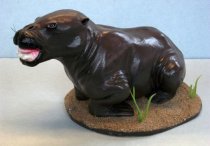
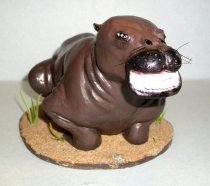
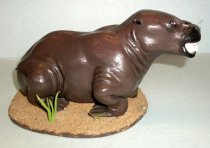
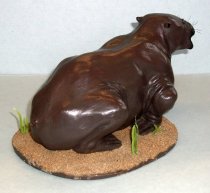
Paleoparadoxia Model, 1966. Model of Paleoparadoxia [now classified as Neoparadoxia repenningi] created by Dr. Charles A. Repenning, Vertebrate Paleontologist and Marine Mammal Specialist for the USGS, 1966. Ceramic model is created at 1:12 scale where 1 inch equals one foot. Base is a round circle covered with hardened sand from which the animal is mounted in the center surrounded by four green plastic grass clumps. Hippo-like creature is painted brown, has a large head with very small ears, blunt teeth that project slightly forward, a small nub of a tail and flipper-like front and back feet. The front feet are bent toward the back as if the creature is resting on the front of his wrists or the back of his "hands." According to a label previously displayed at SLAC, "The model of the animal is based on the shapes of the preserved bones, in conjunction with our knowledge of the anatomy of similar animals alive today. Such restorations are necessarily somewhat conjectural. Dr. Charles A. Repenning, a vertebrate paleontologist and marine mammal specialist working for the US Geological Survey, created the restoration from his detailed studies of the fossil skeleton. The back-handed rest position emphasizes the distinctive feature of the Paleoparadoxia wrist joint. A bony flange at the end of the lower limb bone extends down, preventing the forepaw from swinging up in the forward direction. This flange prevented the animal from standing "plantigrade" (standing with its weight on the flat of the foot); it could only stand on its toes. This feature was actually an adaptation for swimming and tells us that these animals used their front limbs for the downward power stroke, which pushed the animal through the water. The foot could not flip up while pushing through the water, but could fold back for the return stroke." |
Date |
1966 |
Creator |
Repenning, Charles A. |
Role |
Scientist |
Catalog Number |
2015.013.001 |
Dimensions |
H-4.75 W-9.25 D-5.25 inches |
Collection |
3D - Medical & Psychological Tools & Equip. |
Kingdom |
Animalia (Animals) |
Phylum |
Chordata (Chordates) |
Class |
Mammalia (Mammals) |
Order |
Desmostylia |
Family |
Paleoparadoxiidae (ancient paradox) |
Genus |
Neoparadoxia |
Species |
N. repenningi |
Inscription Text |
none |
Provenance |
Charles A. Repenning, a vertebrate paleontologist and marine mammal specialist working for the US Geological Survey, created the restoration from his detailed studies of the fossil skeleton. |
Notes |
This model was on display at the San Mateo County History Museum when it was located at the College of San Mateo and then was part of the education department. "Paleoparadoxia Name: Paleoparadoxia (Ancient puzzle) Phonetic: Pay-le-o-pah-rah-dox-e-ah. Named By: R.H. Reinhart 1959. Classification: Chordata, Mammalia Desmostylia. Species: P. tabatai (type), P. media, P. repenningi, P. weltoni. Diet: Herbivore. Size: Around 2.5 meters long. Known locations: Japan- Haraichi Formation, Haratajino Formation, Kurosedani Formation, Nagura Formation, Niwaya Formation, Satiama Prevecture, Sekinohana Formation, Tonokita Formation, Ushikubitoge Formation, Yamanouchi Formation. USA, California - Ladera Sandstone Formation, Monterey Formation, Oclese Sand Formation, Santa Margarita Formation, Skooner Gulch Formation, Temblor Formation, Topanga Formation. Mexico, Baja California - Torgugas Formation. Time period: Aquitanian through to the Tortonian of the Miocene. Fossil representation: Remains of multiple individuals. The first description of Paleoparadoxia remains was published in 1939 by Tokunaga as Cornwallius tabatai. The genus Paleoparadoxia was not named until 1959 when R. H. Reinhart published a review of the Sirenia and Desmostylia. Paleoparadoxia was a large quadrupedal mammal that has been identified as a member of the Desmostylia (type genus Desmostylus ) Like other members, the large bulk of the body of Paleoparadoxia meant that it would have been fairly cumbersome on land, but like its relatives, Paleoparadoxia would have actually ventured into the water to feed upon submerged aquatic plants. When in the water, the large body and resulting body weight would have been supported by the water. This means that while swimming Paleoparadoxia might have been quite graceful in the same way that hippos are quite nimble when they are submerged in the water. The lack of specialised aquatic features such as limbs modified into flippers, means that even though Paleoparadoxia swam in the sea, it probably restricted itself to the shallows. Relatively shallow water environments would have also had the greatest abundance of plant growth since the shallows would have had a greater concentration of sunlight as well. The mouth of Paleoparadoxia is broad and bucket shaped which means it was likely capable of scooping up large quantities of plant matter with a single bite. Because Paleoparadoxia still had functioning legs and feet, it of course would have returned to the land. It is impossible to say if mating and birth took place on land or in the water where buoyancy could have supported the individuals, though other large mammals are known to be capable of not needing to enter the water. Paleoparadoxia however almost certainly rested and slept on land however, and by being able to walk, it may have been able to enter bodies of water such as lagoons rather than just relying upon the sea. Paleoparadoxia certainly did swim in coastal regions of the sea since its remains have been discovered in Japan and the Western coasts of the USA and Mexico. Rather than swim across several thousand miles of open and deep water with nothing to eat, Paleoparadoxia were likely spread across the entire Northern rim of the Pacific Ocean, from what is now known as mainland Asia, Beringia (better known as the Bering land bridge but is now submerged) to Canada and the Upper United States. By hugging the coastlines, Paleoparadoxia would have had both access to food and areas to rest, and future fossil discoveries, especially from Miocene age rock, may one day reveal a more complete distribution of this genus. Further reading -A review of the Sirenia and Desmostylia, R.H. Reinhart - 1959. -The Stanford Skeleton of Paleoparadoxia (Mammalia: Desmostylia) N. Inuzuka - 2005. -A new early Miocene species of Paleoparadoxia (Mammalia: Desmostylia) from California, J.M. Clark - 1991. -An outline of the Miocene cetotheres of Japan, T. Kimura and Y. Hasegawa - 2004. -Desmostylian fossils from the Yatsuo Group in Toyama Prefecture, Central Japan and their paleoenvironments, K. Kaneko and N. Inuzuka - 1992. -Miocene marine vertebtates from San Clemente Island, California, E. D. W. Mitchell and J. H. Lipps - 1964. -A partial skeleton of Paleoparadoxia from San-yama, Ogano-cho, Saitama Prefecture, central Japan, H. Saegusa - 2002. -A smaller manus of the Paleoparadoxia (Mammalia: Desmostylia) from the Haratajino Formation, Tomioka Group, Gunma, Japan, H. Yoshikazu, K. Toshiyuki & M. Ryosuke - 2006. -Desmostylian tooth remains from the Miocene Tokigawa Group at Kuzubukuro, Saitama, Japan, K. Shimada & N. Inuzuka - 1994. -Paleoparadoxia tabatai from Yanagawa-machi, Fukushima Prefecture, Northeastern Japan, Y. Hasegawa and Y. Taketani - 1994." [http://www.prehistoric-wildlife.com/species/p/paleoparadoxia.html] |
Search Terms |
Menlo Park Models Neoparadoxia repenningi (formerly Paleoparadoxia) Paleontology Repenning, Dr. Charles SLAC National Accelerator Laboratory |
Subjects |
Animals Models Nature Paleontology |
People |
Repenning, Dr. Charles |
Credit line |
Courtesy of the Unites States Geological Survey (USGS) |