
Object Record
Images
Metadata
Title |
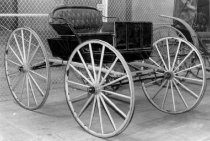
c. 1890 Single-seat Buggy |
Object Name |
Buggy |
Description |
c. 1890 Single-seat Buggy has a bench seat with black leather tufted upholstery stuffed with horse hair. Wooden body and wheels are painted black and vehicle has rubber tires. |
Date |
c. 1890 |
Creator |
Unknown |
Catalog Number |
1975.236.007 |
Dimensions |
H-58 W-68 D-100 inches |
Collection |
3D - Land Transportation Tools & Equipment |
Provenance |
From the Holbrook-Palmer Collection of the Town of Atherton. |
Notes |
[http://www.britannica.com/EBchecked/topic/83761/buggy] buggy, also called road wagon, light, hooded (with a folding, or falling, top), two- or four-wheeled carriage of the 19th and early 20th centuries, usually pulled by one horse. In England, where the term seems to have originated late in the 18th century, the buggy held only one person and commonly had two wheels. By the mid-19th century the term had come to the United States and the buggy had become a four-wheeled carriage for two passengers. The shapes in which the vehicle was built varied widely. The coal-box buggy and, especially, the piano-box, or square-box, buggy enjoyed great popularity. Without a top a buggy was usually called a runabout, or a driving wagon, and if it had a standing top it was called a Jenny Lind. The buggy became the universal American vehicle, and by the 1870s its popularity, along with that of the road cart and the spring wagon, brought about the mass production of carriages in Cincinnati, Ohio, and other carriage-building centres. This led to price reductions that further stimulated the popularity of the buggy. It was the Model T Ford of its day, and it continued to be widely used for 10 or 15 years into the 20th century. This carriage currently in storage and not available for viewing. |
Search Terms |
Holbrook-Palmer Atherton Buggy Carriage Carriages Horse Drawn Vehicles |
Subjects |
Carriages & coaches Transportation |
People |
Holbrook-Palmer, Olive |
Credit line |
Courtesy of the Town of Atherton |