
Object Record
Images
Metadata
Title |
James E. Swett Challenge Coin |
Object Name |
Coin, Commemorative |
Description |
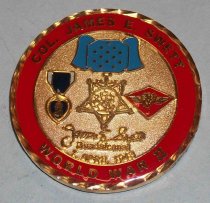
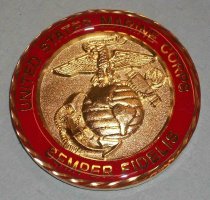
James E. Swett Challenge Coin. Coin recognizing James E. Swett's service in 1943 at Guadalcanal during WWII where he received a Congressional Medal of honor and a Purple Heart. This coin is made of gold with a red striped painted rim with a gold edge and red painted field. At the top front of the coin, there is some gold embossed text that reads "COL. JAMES E. SWETT". At the bottom front of the coin, there is some gold embossed text that reads "WORLD WAR II". Both of the text "COL. JAMES E. SWETT" and the text "WORLD WAR II" are in bold. Inside the middle of the coin, at the top, painted in blue, there is a octagon with thirteen gold stars with one blue rectangular shape on each side of the octagon, which is connected a gold star at the bottom. This is the symbol for the United States Medal of Honor. Below the octagon, on the left, there is a symbol of a purple heart medal which has purple and white stripes at the top with the base shaped as a heart with the embossing of picture of a person in the middle. At the far right, with a thin line of gold around a red painted background, is some gold wings with gold embossed text that reads "I". Below the gold star, embossed in gold, the text reads "James E. Swett / Guadalcanal / 7, April 1943". The text "James E. Swett" is in cursive with medium lettering. The text "Guadalcanal" is in small lettering. The text "7, April 1943" is in bold with small lettering. On the reverse side of the coin, there is a red painted legend with golden embossed text that reads "UNITED STATES MARINE CORPS" at the top, and "SEMPER FIDELIS" at the bottom. Both "UNITED STATES MARINE CORPS" and "SEMPER FIDELIS" are in bold. In the middle of the challenge coin, in embossed in gold, is the symbol of a eagle sitting on a globe with an anchor wrapped around the globe. This is a symbol for the Marine Corps. At the top, the eagle is holding on to a sheet of paper by its beak at the top, embossed in gold with bold with tiny lettering that reads "SEMPER FIDELIS". |
Date |
n.d. |
Creator |
Unknown |
Role |
Manufacturer |
Catalog Number |
2016.034.001 |
Dimensions |
H-1.75 W-1.75 D-0.25 inches |
Collection |
3D - Documentary Objects |
Inscription Text |
"COL. JAMES E. SWETT" & "WORLD WAR II" (embossed in gold and in bold at the top and bottom front of the coin around the red painted field) "James E. Swett / Guadalcanal / 7, April 1943" (embossed in gold in the bottom middle of the coin with the text "James E. Swett" is in cursive with medium lettering, the text "Guadalcanal" is in small lettering, and the text "7, April 1943" is in bold with small lettering) "UNITED STATES MARINE CORPS" & "SEMPER FIDELIS" (embossed in gold and in bold within the red painted legend at the reverse or back of the coin) "SEMPER FIDELIS" (embossed in gold and in bold with tiny lettering on a small sheet of paper on the beak of the eagle) |
Notes |
"A challenge coin is a small coin or medallion (usually military), bearing an organization's insignia or emblem and carried by the organization's members. Traditionally, they are given to prove membership when challenged and to enhance morale. In addition, they are also collected by service members. In practice, challenge coins are normally presented by unit commanders in recognition of special achievement by a member of the unit. They are also exchanged in recognition of visits to an organization…The Roman Empire rewarded soldiers by presenting them with coins to recognize their achievements. According to the most common story, challenge coins originated during World War I. Before the entry of the United States into the war in 1917 American volunteers from all parts of the country filled the newly formed flying squadrons. Some were wealthy scions attending colleges such as Yale and Harvard who quit in mid-term to join the war. In one squadron, a wealthy lieutenant ordered medallions struck in solid bronze and presented them to his unit. One young pilot placed the medallion in a small leather pouch that he wore about his neck. Shortly after acquiring the medallion, the pilot's aircraft was severely damaged by ground fire. He was forced to land behind enemy lines and was immediately captured by a German patrol. In order to discourage his escape, the Germans took all of his personal identification except for the small leather pouch around his neck. In the meantime, he was taken to a small French town near the front. Taking advantage of a bombardment that night, he escaped. However, he was without personal identification. He succeeded in avoiding German patrols by donning civilian attire and reached the front lines. With great difficulty, he crossed no-man's land. Eventually, he stumbled onto a French outpost. Saboteurs had plagued the French in the sector. They sometimes masqueraded as civilians and wore civilian clothes. Not recognizing the young pilot's American accent, the French thought him to be a saboteur and made ready to execute him. He had no identification to prove his allegiance, but he did have his leather pouch containing the medallion. He showed the medallion to his would-be executioners and one of his French captors recognized the squadron insignia on the medallion. They delayed his execution long enough for him to confirm his identity. Instead of shooting him they gave him a bottle of wine." [https://en.wikipedia.org/wiki/Challenge_coin-1/19/2017] "James Elms Swett (June 15, 1920 – January 18, 2009) was a United States Marine Corps fighter pilot and ace during World War II. He was awarded the United States' highest military decoration, the Medal of Honor, for actions while a division flight leader in VMF-221 over Guadalcanal on April 7, 1943. Subsequently he downed a total of 15.5 enemy aircraft during the war, earning eight Distinguished Flying Crosses and four Air Medals. Born on June 15, 1920 in Seattle, Washington, James E. Swett graduated from San Mateo High School, San Mateo, California, and enrolled at the College of San Mateo in 1939. He earned a private pilot’s license, which amounted to 450 more hours of flying than he received during his Navy flight training. He enlisted in the U.S. Naval Reserve as a seaman second class on August 26, 1941, and started flight training in September...On April 7, 1943, on his first combat mission, Swett both became an ace and acted with such "conspicuous gallantry and intrepidity at the risk of his life above and beyond the call of duty" that he would be awarded the Medal of Honor." [https://en.wikipedia.org/wiki/James_E._Swett] "Mr. Swett was a first lieutenant and division leader in the Solomon Islands area of the South Pacific when he earned the Medal of Honor, the military's highest award for valor. As part of the Guadalcanal campaign, Japanese Adm. Isoroku Yamamoto had ordered a massive daylight offensive involving at least 150 Japanese bombers and fighter escorts. The Allies had about half that number of planes, one of which carried Mr. Swett. He was leading his division of four Wildcat planes April 7, 1943, when another pilot spotted the enemy and radioed, "There's millions of 'em!" Over Tulagi island, Mr. Swett saw about 20 lightly armored Japanese Val dive bombers trying to target Allied ships. Mr. Swett made his first attack within 300 yards of a dive bomber, marking his first kill, and followed quickly with bursts of fire on two more Vals -- sending both spiraling down in flames. He became separated from his division during the incident but managed under intense enemy gunfire to down four more Japanese bombers. While engaging yet another, he ran out of ammunition and was hit by that Val's rear gunner. Parts of his shattered windscreen scraped against his face, and his engine caught on fire. One wing was already damaged by antiaircraft flak. He lowered his plane before bracing for a strong impact against the sea. He broke his nose and was dragged down 25 feet into the water before wiggling free from the cockpit and surfacing in an inflated life jacket. He feared his bleeding nose might attract sharks. A cautious sailor spotted Mr. Swett and asked, "Are you an American?" The Marine replied yes, adding an epithet, and was treated to Scotch and morphine, according to an account by military historian Edward Sims. The heavy Japanese losses that day played a significant role in stopping the Japanese advance in the Pacific. Mr. Swett refused to return to the United States after receiving the Medal of Honor because he thought his training expertise was of greater use in combat. In early 1945, Mr. Swett was assigned to piloting Corsairs off the aircraft carrier Bunker Hill and racked up 8.5 more victories in a squadron designed as an anti-kamikaze force. After one mission against a Japanese suicide operation, he was about to land on the Bunker Hill when it was struck by two Japanese planes and nearly 400 men were killed. He dropped dye markers in the water to help spot crewmen who had jumped from the ship and, with his fuel level very low, made a harrowing landing aboard the carrier Enterprise. His plane was shoved overboard to make way for more airplanes."[http://www.washingtonpost.com/wp-dyn/content/article/2009/01/22/AR2009012203755.html-1/19/2017] |
Search Terms |
Coins Memorabilia Military Navy Swett, James E. World War II World War Two |
Subjects |
Coins Marines (Military personnel) Medals Memorabilia Soldiers War World War II |
People |
Swett, James E. |
Credit line |
Courtesy of John Swett |