Object Record
Images
Metadata
Title |
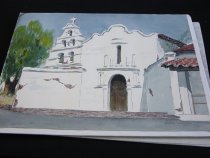
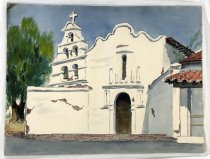
San Diego de Acala Mission by Marian Goodman, 1985. |
Object Name |
Painting |
Description |
San Diego de Acala Mission by Marian Goodman, 1985. An 18th century Roman Catholic Spanish Mission, a white building with red roof, one brown window, one brown door, one tower with five green and gray bells and a white cross on top of it. By the left side of the building there is a tall tree. |
Date |
n.d. |
Creator |
Goodman, Marian |
Role |
Artist |
Medium |
Watercolor Paint |
Catalog Number |
1989.382.010 |
Dimensions |
H-20.25 W-26.25 inches |
Collection |
3D - Art |
Inscription Text |
"SAN DIEGO DE ACALA / MISSION" (handwritten w/ pencil on the back of painting, top left corner) "MARIAN GOODMAN" (handwritten w/ pencil on the front, low right corner) |
Notes |
"On July 16, 1769, Father Serra established Mission San Diego and the California mission system was begun on a site overlooking the bay. The mission remained at this site for only five years; the water supply was not reliably sufficient to sustain the crops. The soil was not fertile enough and the American Indians were intimidated by the military. The decision to move the mission six miles east was made by the pastor, Father Luis Jayme (a young Majorcan) and approved by Father President Serra. The new site was close to the San Diego River and the Kumeyaay village of Nipaguay. Father Francisco Palou, in his Historical Memoirs of New California states, "The days while we were detained at the mission of San Diego (about September 1773), we went to examine some places in search of a site suitable for planting. For this purpose we examined the banks of the river in the same valley of San Diego, about two leagues from the mission (the Presidio Hill), although there was danger that the flood would carry the crops away, for they told us that in that place the rains begin early and last longer than at the mission. On the other hand, in case the rains should be short, it would be possible, with some trouble, to dam up the water of the river. This decided, the fathers at once set a hand to preparing the ground at that place, which is named Nuestra Senora del Pilar." From 1769 to 1774, only 116 Indians had been baptized. Father Jayme and the other Franciscan Missionaries had great rapport with the Kumeyaay, baptizing 315 Indians during the summer of 1775. Unfortunately, two of the mission or Diegueno Indians became dissatisfied with the regulations and conditions established by the Spanish authorities, and they incited hundreds of Indians in remote villages to riot. According to Father Francisco Palou's report of the incidence, eight hundred American Indians stormed onto the grounds about midnight on November 4, 1775. They pillaged the mission, burned it to the ground and massacred a blacksmith, a carpenter (mortally wounded), and Father Jayme, who became California's first Catholic Martyr. He is buried next to the altar in the present church. Survivors of the night long attack were one corporal and three Leather Jacket soldiers, one blacksmith, two children who were the son and nephew of the Presidio commandant, and Associate Pastor Father Vicente Fuster. In 1776, Father Serra returned to Mission San Diego de Alcalá to oversee the rebuilding of the mission. Fearing there would be further attacks, the padres rebuilt the mission within a 150 feet quadrangle, with adobe walls 9 feet in height, including 3 or 4 defensive structures of a military type, called ravelins. Reestablishing the mission was a long, difficult process. This mission was always one of the poorest. The land was difficult to till, the water scarce. Slowly, Mission San Diego de Alcalá became more productive. According to the Mission San Diego Accounts Book, from 1778 to 1795 Mission San Diego became known as an efficient horse and mule breeding farm, providing other missions in Alta and Baja California an average of 16 animals per year. San Diego would in turn receive farm products from the surplus of successful grain producing missions. According to Franciscan historian Father Zephyrin Engelhardt, O.F.M., 1797 was our most successful year in spiritual results when 567 baptisms were performed, and neophytes numbered 908. The mission land area encompassed about 55,000 acres, harvesting corn, wheat, barley, kidney beans and chick peas; vineyards produced enough grapes for wine and gardens yielded vegetables.Sometime after 1803, following a two-year drought, the mission Padres and Diegueno Indians built a dam across the San Diego River bed, about 224 feet long, 13 feet wide, and 12 feet high, approximately five miles east of the mission. From the dam, an aqueduct was constructed. It consisted of tiles, resting on cobblestones in cement, and carried by gravity flow a stream one foot deep and two feet wide to mission lands. It was built through the north side of a dangerously steep gorge, impassable on horseback. The 1814 mission year-end report stated that about 3 1/2 miles of the aqueduct had been completed. It is believed that by 1817 the work was completed. By 1825 the mission owned 19,420 sheep, 184 goats, 8,120 cattle, 565 horses and 115 mules. These are amazing achievements considering that the area was arid chaparral with no livestock or large scale farming until the Spanish arrived." [https://www.missionsandiego.org/visit/history/11/12/2019] |
Search Terms |
Mission impact - Indians Mission Period Missions - Architecture Missions - California Spanish - California Spanish Alta-California Spanish Colonial Spanish colonization Spanish Era Water Color |
Subjects |
Mission churches Watercolors |
People |
Goodman, Marian |
Credit line |
Courtey of Marian Goodman |