
Object Record
Images
Metadata
Title |
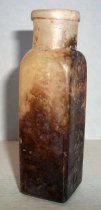
Bottle Recovered from City Centre Plaza, c.1772-1865. |
Object Name |
Bottle, Medicine |
Description |
Bottle Recovered from City Centre Plaza, c.1772-1865. This bottle is square shaped in cross section and it has narrowed slightly from shoulder to base. The rim has prescription finish which is narrow (vertically) and the outside surface distinctly tapers in from the top surface of the finish to bottom. The bottle embossed as follows "Henry's / Calcined / Magnesia /Manchester " with line of lettering on each side. A .75 inch short and narrow neck flares out .375 inches shoulders to a 2.25 inch body. The base is shaped like square. The bottle is clear and shows evidence of glass hand-made manufacture. |
Date |
c.1772-1865 |
Creator |
Henry's Calcined Magnesia Co., Manchester, England |
Role |
Manufacturer |
Catalog Number |
1999.048.357 |
Dimensions |
H-4.375 W-1.25 D-1.25 inches |
Collection |
3D - Medical & Psychological Tools & Equipment |
Inscription Text |
"HENRY'S / CALCINED / MAANESIA / MAACHESTER" (embossed on each side of bottle) |
Provenance |
20 boxes of archaeological material excavated from the City Centre Plaza site at 950 Main at Middlefield in Redwood City. Excavation for development, done by Basin Research Associates. |
Notes |
"Square druggist bottles (in cross section), with and without proprietary embossing, were a relatively commonly used shape ordered and used by many local druggists and drug stores during the mid 19th century until well into the 20th century. Like with the round druggist bottles, the square types seemed to have been less popular than the other general shapes covered next (rectangular and oval). Square bottles were used no more than maybe 5% of the time during the heyday of the mouth-blown prescription bottle which began in earnest in the 1870s and lasted until well into the 1920s (Preble 2002; empirical observations). The most common type of square prescription bottle was widely known as the "French square" (Whitall Tatum 1880, 1924; Illinois Glass Co. 1903; Obear-Nester 1922). " [http://www.sha.org/bottle/medicinal.htm#Rectangular Druggists] "For the cure of acute indigestion, acid stomach, heartburn, and dyspepsia, among other ailments, Henry's Calcined Magnesia was first introduced in 1772 by Thomas and William Henry of Manchester, England. The product was available in the United by at least as early as 1804, where it appears in the company catalog of Jacob Scheiffelin, subsequently named Jacob Scheiffelin & Son in 1805. The company was one of the early New York pharmaceutical firms which bought, sold and imported drugs and medicines, and traded fancy goods, perfumes, and other merchandise. The Scheiffelin family business changed names several times during the succeeding decades. In 1865, it was once again renamed W.H. Schieffelin & Co. As late as 1891, Scheiffelin owned or was an agent for Henry's Calcined Magnesia. Other agents included New York's wholesale druggist, Tarrant and Company, as well Thomas Dyott, who by 1806 was advertising his patent medicine warehouse in Philadelphia. Both firms would ultimately have agents all over the country who very likely peddled bottles of Henry's original remedy. Of the 34 square glass samples recovered from the wreck site of the SS Republic, all with the exception of 2 still contain the remains of the century-old formula. It appears to have originally been a powder-like white substance, now hardened into a solid mass. The cost of the import duty for Henry's Calcined Magnesia seems to have priced it out of the range of the average U.S. consumer. By 1844, it was competing with Husband's Calcined Magnesia, the invention of Thomas J. Husband, a graduate of the Philadelphia College of Pharmacy. Husband's American brand was packaged in a glass bottle virtually identical to that which contained Henry's original British product." [http://odysseysvirtualmuseum.com/products/Henry's-Calcined-Magnesia-Bottle.html 08/02/2016] |
Search Terms |
Apothecary Bottle Collection Bottles City Center Plaza Medicine Redwood City |
Subjects |
Archaeology Bottle industry Bottles Drugstores Medicine |
Credit line |
Courtesy of the City of Redwood City |