
Photo Record
Images
Metadata
Title |
Red Skelton and Mike Bancroft Photograph |
Object Name |
Print, Photographic |
Description |
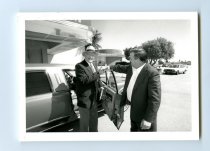
Red Skelton and Mike Bancroft Photograph. Black and white photograph of Mike Bancroft and Red Skelton. Both are wearing suits, with Skelton wearing a hat and Bancroft without a tie. Skelton is standing in front of an open passenger side door of a limousine, facing the camera while smiling, and shaking Bancroft's hand. Bancroft is facing away from the camera, towards Skelton, with one arm reaching over the car door to shake Skelton's hand. Part of collection related to Circle Star that donor's sister, Carol (Selby) Bancroft, collected when she was a limo driver that handled Circle Star performers' transportation (her and her husband Mike operated a limo service). |
Photographer |
Unknown |
Studio |
Unknown |
Catalog Number |
2018.026.005.2C |
Collection |
Archival - Photographs |
Place |
unknown |
Provenance |
Part of collection related to Circle Star Theater that donor's sister, Carole Selby Bancroft, collected when she was a limo driver that handled Circle Star performers' transportation (her and her husband Mike operated a limo service). |
Notes |
"Richard "Red" Skelton (July 18, 1913 – September 17, 1997) was an American comedy entertainer. He was best known for his national radio and television acts between 1937 and 1971, and as host of the television program The Red Skelton Show. He has stars on the Hollywood Walk of Fame for his work in radio and television, and also appeared in burlesque, vaudeville, films, nightclubs, and casinos, all while he pursued an entirely separate career as an artist. Skelton began developing his comedic and pantomime skills from the age of 10, when he became part of a traveling medicine show. He then spent time on a showboat, worked the burlesque circuit, and then entered into vaudeville in 1934. The "Doughnut Dunkers" pantomime sketch, which he wrote together with his wife, launched a career for him in vaudeville, radio, and films. His radio career began in 1937 with a guest appearance on The Fleischmann's Yeast Hour, which led to his becoming the host of Avalon Time in 1938. He became the host of The Raleigh Cigarette Program in 1941, on which many of his comedy characters were created, and he had a regularly scheduled radio program until 1957. Skelton made his film debut in 1938 alongside Ginger Rogers and Douglas Fairbanks, Jr. in Alfred Santell's Having Wonderful Time, and he went on to appear in numerous musical and comedy films throughout the 1940s and early 1950s, with starring roles in Ship Ahoy (1941), I Dood It (1943), Ziegfeld Follies (1946), and The Clown (1953). Skelton was most eager to work in television, even when the medium was in its infancy. The Red Skelton Show made its television premiere on September 30, 1951, on NBC. By 1954, Skelton's program moved to CBS, where it was expanded to one hour and renamed The Red Skelton Hour in 1962. Despite high ratings, the show was cancelled by CBS in 1970, as the network believed that more youth-oriented programs were needed to attract younger viewers and their spending power. Skelton moved his program to NBC, where he completed his last year with a regularly scheduled television show in 1971. He spent his time after that making as many as 125 personal appearances a year and working on his art. Skelton's artwork of clowns remained a hobby until 1964 when his wife Georgia persuaded him to have a showing at the Sands Hotel in Las Vegas while he was performing there. Sales of his originals were successful, and he also sold prints and lithographs of them, earning $2.5 million yearly on lithograph sales. At the time of his death, his art dealer believed that Skelton had earned more money through his paintings than from his television work. Skelton believed that his life's work was to make people laugh; he wanted to be known as a clown because he defined it as being able to do everything. He had a 70-year career as a performer and entertained three generations of Americans. His widow donated many of his personal and professional effects to Vincennes University, including prints of his artwork. They are part of the Red Skelton Museum of American Comedy at Vincennes." [https://en.wikipedia.org/wiki/Red_Skelton] "The Circle Star Theatre was a performing arts venue in San Carlos, San Mateo County, California. Its name is based on it being a theater in the round, featuring a rotating circular stage with none of its 3,743 seats further than 50 feet (15 m) from the stage. Unlike similar venues across the United States, the Circle Star Theatre stage had the ability to rotate in either direction without limit, thanks to the slip ring and brush system that supplied electrical power and lighting signals to it. The theatre's address was 2 Circle Star Way, San Carlos, CA 94070. "In 1971, the theatre was purchased by Marquee Entertainment, run by Don Jo Medlevine of the famed Chicago nightclub Chez Paree. Marquee Entertainment booked Las Vegas acts such as Frank Sinatra, Sammy Davis, Jr., Dean Martin, and Liberace, among many others. In the mid-1970s the theatre was kept solvent by booking Motown acts to increase its diversity.[1] "Don Jo Medlevine sold the Circle Star Theater to Dr. Leonard Bloom. Dr. Bloom later sold the theater to a local car dealer. The new ownership did not have the same elite relationships with the top entertainers as Dr. Bloom had, so it was closed in December 1993.[2] The building caught fire on April 18, 1997, damaging much of the backstage area, though by this time plans had already been made for its demolition.[3] The theater was ultimately demolished to make way for the Circle Star Center, a complex containing two four-story office buildings and a small hotel, since 2015 or 2014 Softbank owns the buildings and uses them as offices. The hotel is now a extended stay America." [https://en.wikipedia.org/wiki/Circle_Star_Theater (8/23/2018)] |
People |
Bancroft, Mike Skelton, Richard "Red" |
Search Terms |
A Sterling Rose Limousine Service Circle Star Theatre |
Subjects |
Celebrities Entertainers Portrait photographs |
Credit line |
Courtesy of Jim Kelly |