
Photo Record
Images
Metadata
Title |
Eimac Photocollage Copy Print |
Object Name |
Print, Digital |
Description |
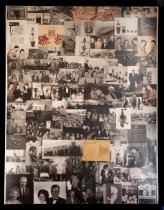
Eimac Photocollage Copy Print, 2016. Color digital copy print on Epson Professional paper shows an image of a photocollage of Eimac history from its founding in 1934 to 1974. Eimac was headquartered in San Bruno, California, and the company produced vacuum tube transmitters and receivers for radio frequency applications. The collage shows multiple snapshots of founders Bill Eitel and Jack McCullough, Eimac facilities, employees, vacuum tubes, advertisements, etc. The copy print is 22" x 17" while the original collage is 44" x 34". The majority of the photographs are black and white, with one color image at top left and several sepia images throughout. At the upper left hand corner, a black and white photo of an advertisement with some white, bold and printed text that reads "AD # 1: November / 1934". The text "AD # 1: November / 1934" is in a black background above a white background in black printed text. The black printed text reads "EIMAC / 150 T / THE TUBE THAT YOU ASKED FOR / IS HERE AT LAST / ON EVERY IMPORTANT FEATURE / UNSURPASSED... / EITAL McCOLLOUGH, INC. / San Bruno, California, U.S.A.". The text "EIMAC / 150 T" is printed in black with small lettering with bold and above the picture of the EIMAC 150T tube. The text "THE TUBE THAT YOU ASKED FOR / IS HERE AT LAST" is printed in black with medium lettering with bold. The text "ON EVERY IMPORTANT FEATURE" and "EITAL McCOLLOUGH, INC. / San Bruno, California, U.S.A" is printed in black with tiny lettering and bold. The text "UNSURPASSED..." is printed in big lettering with bold. Towards the right of the photo of the advertisement is a color photo of a white tube with some red printed text surrounded by a circle that reads "EIMAC" that is next to a collection of tiny flags. Towards the right of the photo of the tube is a black and white photo of a piece of Eimac equipment with some black printed text that reads "EIMAC / 4 x 150A / MADE IN USA", which is a black rectangular square. The text "EIMAC" is in cursive, in bold and in medium lettering, the text "4 x 150A" is in bold with medium lettering and the text "MADE IN USA" is in bold with small lettering and is below the black rectangular square. Next to the photo of the piece of equipment, there is another photo of an Eimac tube which is surrounded by glass with black printed text that reads "EIMAC / 4-65A / MADE IN USA". The printed text "EIMAC" is in cursive, in bold with medium lettering, the printed text "4-65A" is in bold with small lettering, and the printed text "MADE IN USA" is in bold with tiny lettering and is below the black rectangular square. Above the photo of the tube with the text "EIMAC / 4-65A / MADE IN USA", is another black and white photo of a different piece of equipment with some black printed text in a black rectangular square that reads "EIMAC / 2C39A / MADE IN USA". The printed text "EIMAC" is in cursive and bold with medium lettering, the printed text "2C39A" is in bold with small lettering, and the printed text "MADE IN USA" is in bold with tiny lettering and is below the black rectangular square. Towards the bottom left of the photo college, there is a black and white photo of a sign in gold with some text surrounded by a circle that reads "EIMAC", which is in cursive and bold with medium lettering. Below that text above, in the same photo, in gold with small lettering, the printed text reads "division of varian". Towards the right of this photo, there is a black and white photo of a plaque with bold lettering that reads "EIMAC / EITAL McCOLLOUGH, INC. / SAN CARLOS, SAN BRUNO, CALIFORNIA / SALT LAKE CITY, UTAH / THIS FACILITY IS DEDICATED TO / THE THOUSANDS OF FAITHFUL / EIMAC EMPLOYEES WHOSE SERVICE / AND ACHIEVEMENTS THROUGHOUT / THE PAST TWENTY-FIVE YEARS / MADE ITS CONSTRUCTION POSSIBLE. / PRESENTED ON THE SIXTEENTH / DAY OF APRIL 1959." The embossed text "EIMAC" is in the middle of a small circle. The rest of the text on the plaque is in engraved, and in bold with medium lettering. On the bottom right hand corner is a black and white photo of a t-shirt with the face of the founders of Eimac with some black, and bold with big lettering printed text above and below that reads " 1934 / EIMAC / 1974 / PIONEERS OF COMMUNICATION". The text "EIMAC" is in a circle, mostly like an insignia in between the text "1934" and "1974". The text "1934", "1974" and "PIONEERS OF COMMUNICATION" is printed in black and bold with medium lettering. |
Date |
2016 |
Processing Method |
Color |
Catalog Number |
2016.027.001 |
Dimension Details |
22" x 17" |
Collection |
"Archival Collection |
Provenance |
Copy print provided by donor, taken from original. |
Notes |
"In 1932 two radio amateurs, Jack McCullough (W6CHE) and Bill Eitel (W6UF), decided to build high power transmitters to work some of the 20 meter overseas stations being heard in California. They found to their dismay that the expensive transmitting tube they purchased refused to work at 1,000 volts and that was all the high voltage their power supply would provide for them. Both were employed by the San Francisco, California, manufacturing firm of Heintz & Kaufmann, Bill Eitel and Jack McCullough convinced company president Ralph Heintz to allow them to develop a transmitting tube that could operate at lower voltages than those then available to the amateur radio market, such as the RCA 204A or the 852. Their efforts resulted in the design and production of the HK-354 tube. They decided they could build a better tube themselves that would work at low voltage. They borrowed a modest sum and in 1934 started a company with only three people. The product was the 150T triode. From this humble beginning, the company expanded steadily. Other tubes were added to the line and the number of personnel increased slowly. In late 1935 some tubes were sold to the U.S. Naval Research Laboratory for use in an experimental radar set that worked on 200 MHz. The 50T was the only tube that provided sufficient pulse power and that was able to stand up to the high plate voltage. More tubes were ordered by the military and in 1939 the first Navy sea radar tests used EIMAC tubes. During 1938, the U.S. airways were developing radio beacons and high frequency radio links all over the United States. A new EIMAC tube type (450TH) was chosen for this service, and a number of other types were used for broadcast radio, including the newly-developed Armstrong FM broadcast service, and experimental television service. Radio amateurs worldwide also used EIMAC tubes as their popularity grew and dependability became known. Eitel and Armstrong were close and regularly met to discuss problems and fixes. Here is an extract of one such collaboration. Eitel & Armstrong #817.pdf In 1940 the company received its first big war order from Western Electric for the delivery of 10,000 tubes! Up to now, an order for fifty tubes would be a cause for celebration. Converting the plant from using hand methods to mass production kept everyone working night and day for months, sent the hiring rate skyrocketing and tossed out all standard construction methods and routines. By July, 1941, the original staff was some ten times as large as it was a year earlier and the plant was doubled in size to accommodate the growing work. Expansion of the company was so fast that a second plant was opened in Salt Lake City, Utah. By 1945, EIMAC had grown to employing over 1800 people and nearly 3,500 vacuum tubes per day of all types were being manufactured. With the end of hostilities in 1945 and the subsequent cancellation of government contracts brought about a crisis at Eitel McCullough, Inc. Tube production levels fell to near-zero as government stocks of surplus tubes were dumped on the market for as little as fifteen cents each. The Salt Lake City plant was sadly closed. Foreseeing the end of the war, however, EIMAC engineers had evolved new tube types, including production of the new beam tetrode (4X150A) which performed well in the VHF region. At the same time, a new Salt Lake City plant was opened to make television picture tubes (CRT's). The future of the company now no longer depended upon the older tubes that were so plentiful on the surplus market. One feature of the Salt Lake City plant was that it manufactured every component of the tube under the one roof. In 1958 a new Eitel-McCullough plant was built in San Carlos, California, for production of new tetrode tubes, plus larger tubes for broadcast and TV service. At the same time, TV klystrons and other microwave devices were developed for troposcatter communications. In 1965, Eitel-McCullough merged with Varian Associates of Palo Alto, California. The Varian EIMAC divisions continue to produce all types of transmitting tubes, and are known worldwide as a leader in advanced tube design. Super-power tubes were developed and built for broadcast service, with up to 1.5 megawatt anode dissipation, and special tube types are constantly being developed for research studies and experimentation. Varian EIMAC has pioneered the use of Pyrolytic grids in power tubes for the broadcast industry, making use of a 'novel laser-milling operation to achieve increased tube performance, stability and higher power output. Modern Varian EIMAC manufacturing techniques have led to improved VHF performance in large power grid tubes, such as the 4CW300,000G. Other modern Varian EIMAC products are used in the Department of Energy's fusion research program. The latest development, the Klystrode, combines the better features of the klystron and the tetrode and is in production along with many other new tubes. In 1984, Bill Eitel and Jack McCullough both retired, and maintained a strong interest in the company and, of course, in their amateur radio activities. The EIMAC divisions of Varian owe a great deal to amateur radio for it was in this field that many of the early transmitting tubes proved their worth and-even today-many of the company's customers are radio amateurs. As Bill and Jack said, "If it were not for amateur radio, EIMAC could never have existed."" [http://ethw.org/Eimac-1/3/2017} |
People |
Eitel, William McCullough, Jack |
Search Terms |
Eimac Eitel, William McCullough, Jack San Bruno |
Subjects |
Collages Employees Founding History |
Credit line |
Courtesy of Jack McCullough |