Search Term Record
Metadata
Name |
Laundry |
Number of Archive records |
0 |
Number of Object records |
36 |
Number of Photo records |
0 |
Number of Library records |
0 |
Related Records
-
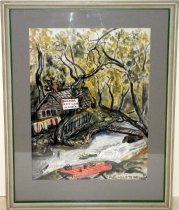
Belmont Creek by Ruth Garber Hulstede, 1955 - Painting
Belmont Creek Painting by R.G. Hulstede, 1955. Watecolor on paper mounted under glass behind a gray-colored mat in a gray wooden frame with a green inner border. Image depicts a fast-moving creek with large trees in the background. A small building with a red chimney, a large window and laundry hanging on a line out front sits behind a tree on the back side of the creek. A white sign on the tree says, "DANGER / DO NOT WADE / IN CREEK." A...
Record Type: Object
-
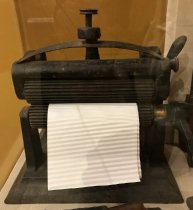
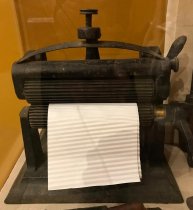
Crimping Iron for Collars and Cuffs, c. late 1880s - Iron, Fluting
Crimping Iron for Collars and Cuffs, c. late 1880s. Small hand-cranked machine for ironing crimps. Machine is composed of a heavy iron base and standing brackets in which two fluted rollers are affixed horizontally. The two rollers sit one on top of the other, and the fabric is fed through the space between by turning the wooden handle on the bottom roller. The bottom roller is removable so it can be exchanged for another one with a different int...
Record Type: Object
-
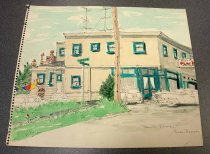
Dan's Place Moss Beach - Painting
Unframed watercolor painting entitled "Dan's Place Moss Beach" by James W. Crawford (American, 1920-2005). Watercolor on paper. December 30, 1973. 14 x 17 inches. Image depicts a two-story white building. Restaurantfront door and window frames are a light teal color. A utility pole is in front of the building and centered on the page. Two cars have been penned on the front far right center of the page. A "Dan's / "Place" hangs on the fro...
Record Type: Object
-
Flat Oval Sleeve Iron, c. late 1880s - Iron
Flat Oval Sleeve Iron, c. late 1880s. Small oval-shaped iron with elongated offset handle with wood grip. Iron head is 3.5" long and .5" thick, with a tapered upper rim and a decoration stamped onto the top. The decoration depicts a beehive in the center where the handle joins the iron, surrounded by a squared border and floral designs on either side. The handle is a long thin rod, running parallel to the length of the iron. It is attached at a s...
Record Type: Object

-
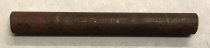
Fluting Iron Heating Rod, c. late 1880s - Iron, Fluting
Removable Heating Rods for Crimping Iron, c. late 1800s. One of three metal rods used interchangeably to provide heat to the rotary crimping machine. Rods are heated and inserted into the hollow centers of the rollers, using tongs. This provides heat to set the crimp created by the machine.
Record Type: Object
-
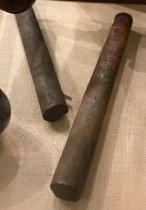
Fluting Iron Heating Rod, c. late 1880s - Iron, Fluting
Removable Heating Rods for Crimping Iron, c. late 1800s. One of three metal rods used interchangeably to provide heat to the rotary crimping machine. Rods are heated and inserted into the hollow centers of the rollers, using tongs. This provides heat to set the crimp created by the machine.
Record Type: Object
-
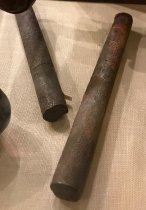
Fluting Iron Heating Rod, c. late 1880s - Iron, Fluting
Removable Heating Rods for Crimping Iron, c. late 1800s. One of three metal rods used interchangeably to provide heat to the rotary crimping machine. Rods are heated and inserted into the hollow centers of the rollers, using tongs. This provides heat to set the crimp created by the machine.
Record Type: Object
-
Removable Roller for Crimping Iron, c. late 1800s - Iron, Fluting
Removable Roller for Crimping Iron, c. late 1800s. Fluted hollow cylindrical roller with wooden handle, for use in crimping iron (Yee 1.1). Made of iron. Wooden handle is threaded on an iron dowel so that it turns freely from the rest of the piece. The handle is pear-shaped and stained a mahogany color. Crimps are .0625" wide.
Record Type: Object
-
Removable Roller for Crimping Iron, c. late 1800s. - Iron, Fluting
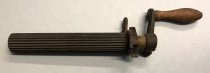
Removable Roller for Crimping Iron, c. late 1800s. Fluted hollow cylindrical roller with wooden handle, for use in crimping iron (Yee 1.1). Made of iron. Wooden handle is threaded on an iron dowel so that it turns freely from the rest of the piece. The handle is a narrow pear shape and stained a medium brown. Crimps are .125" wide. Two freely moving iron pieces are threaded onto the roller in front of the handle joint. One piece is a curved lever...
Record Type: Object
-
Sketch by Alvin Page Colby, c. 1918-1919 - Sketch
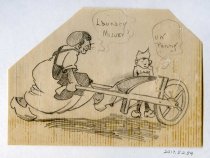
Sketch by Alvin Page Colby, c. 1918-1919. Pencil on off-white paper sketch depicts two people and a one-wheeled cart. The person on the right (probably an older woman) wears clogs, a dress, and an apron, and pushes the cart, one foot resting on it. Her dialogue bubble asks "Laundry Misuer?" The other person is a man standing behind the cart. He also apparently wears clogs, as well as a cap. He smokes a cigarette and his dialogue bubble says "UN P...
Record Type: Object
-
Sleeve Iron, c. late 1880s - Iron
Medium Spade-Shaped Sleeve Iron, c. late 1880s. Small tapered-front iron with elongated offset metal handle and wood grip. Iron is 2.5" long and .3125 (5/16)" thick. It has a pear shape with a rounded back and a tapered point. The thickness of the iron has a beveled edge. The iron is bolted to the metal handle with two rivets. The handle is very thin and long, with two bends to provide even pressure and control. At the end of the handle is a cyli...
Record Type: Object

-
Sleeve Iron, c. late 1880s - Iron
Tiny Spade-Shaped Sleeve Iron, c. late 1880s. Small tapered-front iron with elongated offset metal handle and wood grip. Iron is 1.25" long and .25" thick. It has a pear shape with a rounded back and a tapered point. The thickness of the iron has a beveled edge. The iron is bolted to the metal handle with two rivets. The handle is very thin and long, with two bends to provide even pressure and control. At the end of the handle is a cylindrical wo...
Record Type: Object

-
Small Rounded Spade-Shaped Sleeve Iron, c. late 1880s. - Iron
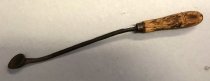
Small Rounded Spade-Shaped Sleeve Iron, c. late 1880s. Small tapered-front iron with elongated offset metal handle and wood grip. Iron is 1.5" long and .25" thick. It has a pear shape with a rounded back and a tapered point. The thickness of the iron has a beveled edge. The iron is bolted to the metal handle with two rivets. The handle is very thin and long, with two bends to provide even pressure and control. At the end of the handle is a cylind...
Record Type: Object
-
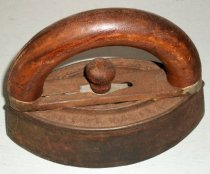
W.D. Howell Company Sadiron, c. 1830-1880 - Sadiron
W.D. Howell Company Sadiron, c. 1830-1880. Sadiron has a thick solid iron base (A) with a detachable wooden handle (B). Oblong iron metal base (A) has pointed ends, rounded sides, a smooth bottom. A lid is screwed to the top of the base with flathead screws that sit just below where handle rests. Lid has two back-to-back, D-shaped perforations in the top center. There is a raised border around the perforations, outside of which are embossed ...
Record Type: Object