Person Record
Metadata
Name |
Easterday, Sybil |
Notes |
One of the most interesting local artists that no one ever heard of is Sybil Easterday. From 1899 until 1903, she was featured in newspapers all over the country. Later she retired to obscurity south of Half Moon Bay and lived out her life. Sybil seemed destined for fame. One of her teachers coached her in reciting a poem for a Fourth of July picnic. The eight year old with big blue eyes and reddish brown curls dazzled the crowd with her performance. The professor began booking her for appearances at church groups and fraternal organizations, etc. She was billed "Little Sybila, the Child Genius." Music was added after Sybil's father bought her a harp. Sybil's flair for the dramatic developed early. In her teens, Sybil began painting lessons. Fortunately, the neighbor who taught her was famous for his work and was one of the founders of the San Francisco Art Association. Probably with his encouragement, she enrolled at the Mark Hopkins Institute of Art, the finest art school in the West. She studied under the best artists for four years. Her mother, Flora, was a gifted musician from the Littlejohn family of Redwood City. She gave up any dreams of being a concert pianist when she married Solomon Easterday, a civic-minded mortician of San Jose. Sometime after Sybil was born in 1876, the Easterdays moved to the East Bay. Solomon went into the contracting business. Sybil was a beautiful but frail child. She was educated by tutors and from an early age enjoyed creating figures in mud or butter or putty. The sculpture teacher required his students to attend weekly anatomy lectures and also take life-drawing classes using nude models. This was very shocking for that day. Boy's and girl's classes were segregated. The custom had been for art students to learn their anatomy from classical statuary. After completing her studies at the Mark Hopkins, Sybil set up a studio in San Francisco. This is the point at which Sybil became featured in Sunday supplements throughout the country. It was not her art that attracted attention, although it was very good. It was her attire that reporters wrote about. She wore men's trousers, a man's shirt and low cut shoes to work! When not working, Sybil wore the usual feminine attire of the day. The quotes she gave reporters on her devotion to her art were just the thing to attract even more publicity. Sybil decided to try a career in Mexico City. In 1903, she had a letter of introduction to the President of Mexico, Porfirio Diaz. She did a portrait of him, and this began a series of celebrity sculptures. She also developed an active social life while there. In 1905 Sybil returned home, apparently heartbroken over a love affair. She decided to give up her sculpting career. Her father bought land at the mouth of Tunitas Creek, where the family had often gone camping, and built a home. Then Solomon died in 1911. Sybil married Louis Charles Paulsen, a local tavern keeper. He died three months after the wedding. Sybil and her mother lived quietly after that until Flora died in 1951. The Highway Department gave Sybil notice to vacate her home on Tunitas Creek in 1960 because a new highway was to be built. Sybil was clearing out the house when she became ill and passed away in 1961. (Joan Levy/2003) See also, "Sybil Easterday, Sculptress (1876-1961)", La Peninsula, Vol. XVI, No. 3, October, 1971, pp 8-15. |
Othernames |
Sybil Paulson |
Born |
November, 1876 |
Birthplace |
San Jose, CA |
Deceased |
1961 |
Occupation |
Artist |
Titles & honors |
Women's Hall of Fame, 1984 |
Education |
Mark Hopkins Institute of Art |
Places of residence |
San Jose East Bay San Francisco Mexico City Tunitas Creek |
Father |
Soloman Easterday |
Mother |
Flora Littlejohn |
Spouse |
Louis Charles Paulson |
Children |
none |
Related Records
-
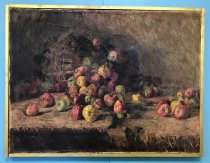
Apples by Sybil Easterday, c. 1900 - Painting
Apples by Sybil Easterday, n.d.. Oil on canvas mounted inside a plain gold-painted wooden frame. Image depicts a brown open-weave basket laying on its side with red, yellow and green apples spilling out onto a brown-colored fringed tablecloth that sits on a brown table.
Record Type: Object
-
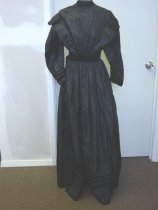
Black Taffeta Dress, c. 1890-1910 - Dress
Black Taffeta Dress, c. 1890-1910. Black taffeta dress, lined; black velvet trim at hem, shoulders, cuffs and belt; black lace at neckline; 8 buttons down front; dress closure with hooks and eyes
Record Type: Object
-
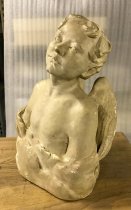
Cupid, 1899 - Bust
Cupid, 1899. Plaster of Paris bust of Cupid, ivory colored surface glaze. Torso only.
Record Type: Object
-
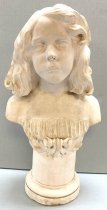
Plaster of Paris Bust of a Girl by Sybil Easterday - Bust
Plaster sculpture created by Sybil Easterday. Plain white plaster bust of a young female, with shoulder length, wavy hair. She is wearing a shoulderless, ruched top that sits above an acanthus leaf motif, which sits on top of a plainly decorated cylindrical pillar. c. 1890. No signature.
Record Type: Object
-
Portraits of Dedication: The San Mateo County Women's Hall of Fame, 1984-1994 - Burgett, Shirley; Svanevik, Michael
Inspirational life stories and photographs of 117 women and teens. Each woman had a cause and tenacity; and many battled social pressures, serious handicaps, and self-doubts to pursue a wide range of community and professional successes and breakthroughs. They are honored, in this book, for their lives of courage and excellence on behalf of their community and world.
Record Type: Library

-
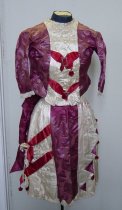
Silk Brocade Dress, 1885 - Dress
Silk Brocade Dress, 1885. Silk brocade maroon 2-piece dress .001) top: white satin inset with red satin ribbons and 2 silver buckles; lace on cuff; 12 silver buttons down back of dress; extra maroon panel down back and side of top; cream cotton lining .002) Skirt: maroon silk brocade with cream satin pleated sides and hem; trimmed with 4 red balls on left side and red ribbon, bows and red ball trim; 1 button closure; burlap lining.
Record Type: Object
-
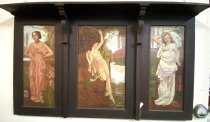
Triptych of Three Women - Painting
Triptych of Three Women, c. 1890-1899. Three section painting of female figures done by Sybil Easterday. Three wooden panels set in a wooden frame with shelp on top and support brackets between paintings. Image line drawing has been burn/etched into panels and then painted. Left image has a woman in a pink dress with hands at hips and three purple irises in the foreground. Center panel depicts a woman in a pale pink dress holding onto tree b...
Record Type: Object
-
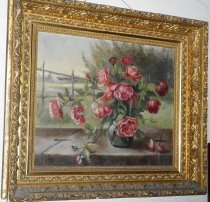
Tunitas Roses by Sybil Easterday, c. 1961 - Painting
Tunitas Roses by Sybil Easterday, c. 1961. Depicts a green vase full of red or pink roses. Background is a landscape that includes a white building and a large tree. Oil on canvas is mounted in an ornate wood and plaster frame that is painted gold.
Record Type: Object